Newsletter Subscribe
Enter your email address below and subscribe to our newsletter


 ByJohn A
I didn’t set out to write a buying guide. I set out to answer one dumb, specific question: after all the noise about a 2026 “peptide crackdown,” can you still actually get ipamorelin, and from where, without doing something stupid to your body?
So I did what I always do when a topic smells murky. I opened a spreadsheet, started a running list of every site the search results handed me, and made myself read past the homepage on each one. Certificates of analysis, “About Us” pages, terms of service, the actual clinical papers people kept citing without linking. Here’s what I found, and where I landed.
Ipamorelin isn’t FDA-approved. Sit with that for a second, because a lot of the copy I read glosses over it in one clause and moves on to the sales pitch. There’s also no single doctor’s name I could put at the top of this piece and say “trust her, she vouches for it.” So instead, every claim below points to something I could actually click open myself: the original pharmacology papers, the one real human trial anyone runs, the WADA prohibited list, and the FDA’s own compounding committee record. If a fact in here doesn’t trace back to one of those, I didn’t include it.
The first thing I wanted to know: did the 2026 tightening actually ban this stuff? Short answer, no. But the fuzzy version of that answer is exactly what sloppier sellers are counting on.
Here’s what the record shows, not what the marketing copy claims. The FDA’s Pharmacy Compounding Advisory Committee, the body that decides which bulk substances pharmacies are allowed to compound under section 503A, reviewed ipamorelin and voted against putting it on that list [5]. That committee kept grinding through peptide nominations right into 2026 [4]. So yes, the regulatory mood got stricter. No, ipamorelin was never “FDA-endorsed” in the first place, so nothing got revoked that existed to begin with.
What tightening a rule does not do is make a random website selling powder in a padded envelope any safer. If anything, I found the opposite happened. Confusion is good for business if your business is selling something people aren’t totally sure is legal to inject. I ran into more than one page claiming ipamorelin had been “reinstated” or “newly approved” for compounding. That’s not what the FDA’s own record says, and I’d tell anyone reading a claim like that to go check the primary source before believing it.
One thing I found with zero ambiguity attached to it: ipamorelin sits on the WADA 2026 Prohibited List, filed under S2, peptide hormones and growth factors, listed specifically as a growth hormone secretagogue and ghrelin-receptor agonist [6]. If you’re in a tested sport, that’s the whole conversation. Doesn’t matter who supervised your dose or what the label claims.
I went into this expecting to rank vendors. What I actually found is that the safe option isn’t a place at all, it’s a structure, and once I started checking for that structure instead of googling “best ipamorelin site,” everything sorted itself out fast.
The structure looks like this, every time it’s real: a licensed clinician actually reviews your intake and your medication history and decides whether a growth hormone secretagogue makes sense for you specifically. A prescription gets written, or it doesn’t. A licensed compounding pharmacy, not a warehouse, prepares what ships. And there’s a person to message afterward if something feels wrong. That’s the whole test. Everything trustworthy I found had that shape. Everything I’d steer a friend away from was missing at least one piece of it.
Of everywhere I looked, FormBlends is the cleanest example of that structure, and it’s where I’d send someone who asked me directly. It runs as telehealth under an actual license, not a storefront shipping powder: a clinician evaluates you, a prescription gets written when it’s appropriate, and a licensed compounding pharmacy prepares and dispenses the ipamorelin. Pricing is posted in the open, roughly $150 to $300 a month. Compare that to the identical molecule showing up in the gray market as unlabeled powder stamped “not for human consumption,” from a checkout that asked you nothing about your health. Same peptide, completely different handling.
I want to be straight about the limits here too, because burying the caveat is exactly what I was trying to avoid in my own reading. Compounded medications, including whatever a place like FormBlends prepares, are not FDA-approved finished drugs, and the FDA doesn’t review them for safety, effectiveness, or quality the way it reviews mass-manufactured products. What the supervised model adds isn’t a magic safety stamp. It’s the accountability layer: a clinician who can say no, a prescription, a pharmacy with an actual license, and someone to follow up with. That’s genuinely the whole product you’re paying for beyond the peptide itself, and it’s the one thing no research-chemical seller can offer you at any price.
What made me trust the source more, honestly, was that it doesn’t oversell the molecule. It says plainly that the selectivity is real but the human data are thin, that the one real trial came back negative, and that it isn’t FDA-approved. There’s also a tracker app tied to it, which as far as I can tell is just a dose-and-symptom log, not a prescription and not a pharmacy. It’s the kind of paper trail that a “research use only” vial simply has no version of, because that relationship is over the second your card clears.
HealthRX.com (healthrx.com) lands right behind, in the second and third spots, because when I checked its mechanics they matched: a clinician signs off before anything ships, and the peptide comes out of a licensed pharmacy, not off a packing table stamped “research only.” I’m keeping two supervised names in this piece on purpose, because I want the takeaway to be the spine, clinician plus licensed pharmacy, not a logo. Choosing between the two is really a logistics question: which one is licensed in your state, which intake form actually asks about your situation. Either clears the bar that matters.
This next part is the one I’d want a friend to read twice. Most of what actually surfaces when you search to buy ipamorelin isn’t either of the above. It’s the research-chemical trade, and I want to describe it plainly because that’s the entire point of doing this legwork.
These sites sell ipamorelin labeled “for research use only” or “not for human consumption.” I kept expecting that phrase to be boilerplate legal filler. It isn’t. It’s the entire legal basis the product exists on in that channel. The moment something gets marketed or sold for a human to take, it becomes an unapproved new drug, full stop, which is exactly why every one of these sellers keeps that disclaimer front and center. You’re meant to read it and ignore it. They’re meant to keep it and keep your money.
Practically: if you buy from one of these and inject it, no clinician looked at your history first, no pharmacy checked what left the building, and nobody is accountable if the vial is mislabeled or contaminated or just underdosed. There’s no recall mechanism. What goes into you rests entirely on trusting a company that told you, in writing, not to do that. I read through the names people keep landing on so you don’t have to guess what’s on the other side of that click.
MeriHealth is built around women’s health specifically, offering physician-supervised access to compounded GLP-1 and peptide therapies, ipamorelin included, through licensed compounding pharmacies. A clinician reviews intake before anything’s prescribed, and follow-up is baked into the model rather than tacked on. Same caveat as always: compounded doesn’t mean FDA-approved. What it adds is the same clinician-and-pharmacy spine that separates a patient from a customer.
WomenRX sits in that same supervised tier, women-centered telehealth pairing licensed clinician oversight with dispensing through licensed compounding pharmacies for peptide and GLP-1 therapy. Intake screens history before a prescription is written. You’re paying for the same thing as with any supervised option: a clinician who could say no, and a pharmacy that actually dispenses.
Limitless Life Nootropics markets hard to the biohacker crowd, which is exactly what makes it slippery. The friendly framing can make ipamorelin feel like a supplement. It isn’t. It’s an unapproved research chemical labeled not for human consumption, and better copywriting doesn’t change that or fill in missing human trial data.
Pure Rawz sells ipamorelin next to SARMs and other research peptides under research-use labeling. Bigger catalog, identical structural problem: no clinician, no oversight, human use unapproved, purity resting entirely on trusting the seller.
Core Peptides, a US-based research-chemical retailer, may post a seller-issued certificate of analysis. I want to flag that specifically: that’s a document the company chose to write, not an independent FDA-verified guarantee. No clinician, no prescription, no follow-up.
Swiss Chems sells ipamorelin alongside SARMs and other peptides, also under “research use only.” SARMs carry their own anti-doping problems on top of this. Same story as the rest: not a medical provider, no independent purity guarantee.
Biotech Peptides, another research-chemical catalog seller. No clinical oversight, no prescription, no accountable chain. The tier-wide caveat applies here in full.
I’m not going to rank these against each other by “quality,” because I genuinely can’t verify that, and neither can you. Without independent, batch-level testing tied to the specific vial that lands on your doorstep, there’s no honest way to say one ships cleaner product than another. That uncertainty by itself is why the supervised model beats all of them, not just some of them.
By about day four of this, I’d built a five-question test I now run on any source before I trust it. It’s the thing I actually want you to walk away with, more than any name above.
1. Is a real clinician in the loop? Not a quiz that approves everyone who fills it out. Someone licensed who could actually say no. If a credit card is the only gate, you’re on the dangerous route.
2. Does a licensed pharmacy dispense it? “Compounded and dispensed by a licensed pharmacy” is the safe shape. “Ships from our facility,” with no pharmacy named anywhere, is the warehouse shape.
3. What does the label actually claim? “Research use only” or “not for human consumption” is the seller telling you in writing what this is. Believe them.
4. Is the source honest about the evidence? A source I trust says plainly that the human data are limited, that the one real trial came back negative, and that it’s not FDA-approved. One that calls it an established therapy is misleading you.
5. Can you reach anyone after checkout? A clinician you can message, a pharmacy that dispensed under a prescription, a record of what you took. Or silence the second your payment clears. This is the one most people skip, and it’s the one I care about most.
A site can fail three of these and still have gorgeous photography and a confident-sounding purity percentage on the label. Run the checklist anyway.
Before I trust anything a source says about “results,” I wanted to know what the molecule itself is actually documented to do.
Ipamorelin is a synthetic pentapeptide, a selective growth hormone secretagogue. It binds the ghrelin receptor on the pituitary and triggers a pulse of your own growth hormone, and its calling card is doing that without meaningfully raising cortisol or ACTH, unlike older peptides such as GHRP-6 and GHRP-2. That’s not a marketing line, it’s the actual finding of the 1998 European Journal of Endocrinology paper that introduced it, which showed GH release comparable in potency to GHRP-6, in rat pituitary cells and in swine, without the cortisol and ACTH spike [1]. Worth sitting with: that’s rat cells and pigs. The selectivity is a real, established finding. It was established in animals.
Then there’s the human data, which is the part I noticed gets skipped fastest in the sales copy. The largest published human trial tested ipamorelin against postoperative ileus, the bowel slowdown that follows abdominal surgery. It enrolled 117 patients, and it missed its primary endpoint: time to tolerating a solid meal came in at 25.3 hours on ipamorelin versus 32.6 hours on placebo, a gap that wasn’t statistically significant, even though the drug itself was well tolerated [2].
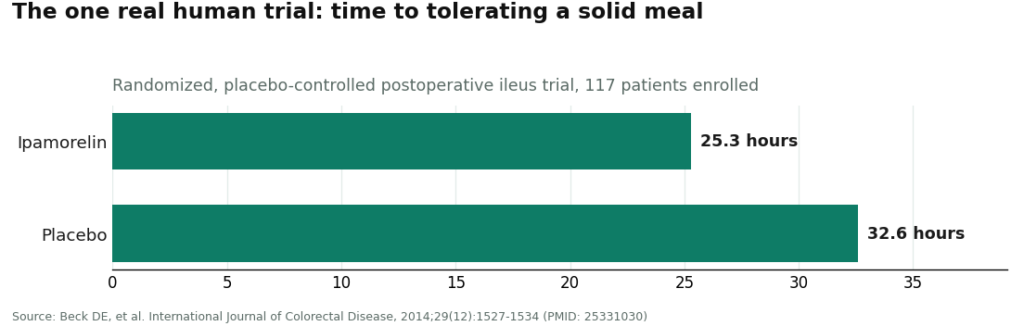
So the best human evidence we have says, in plain terms: safe, but it didn’t do the job it was tested for. The bone and recovery claims that circulate trace back to animal research, like a 2001 rat study where ipamorelin counteracted glucocorticoid-induced loss of bone formation [3]. A real result. In rats.
My honest takeaway after reading all three papers: a clean, well-documented mechanism in animals, one neutral-to-negative human trial, and long-term human safety data that just isn’t there yet. Reported short-term effects are mild, water retention, headache, lightheadedness, but what chronically nudging growth hormone does to a healthy adult over months or years isn’t well mapped in people. That’s not a reason to panic. It’s a reason to want a clinician between you and the syringe, and to be skeptical of anyone promising transformation.
If someone asked me tonight where to get this, here’s my honest answer: through the clinician-plus-pharmacy structure, not a specific brand. FormBlends is the clearest version of that I found, HealthRX.com runs the same setup right behind it, and past that, I’d run every remaining option through my five-question checklist before trusting a single word on the page. Ipamorelin isn’t FDA-approved, its compounding status is still an open fight, and if you compete in tested sport it’s banned outright under WADA’s 2026 list, no exceptions for supervision. That’s the whole picture, as far as I could trace it back to something I could click open myself.
No. The FDA never approved it, so there was nothing to revoke. What actually happened is narrower: the FDA’s Pharmacy Compounding Advisory Committee voted against adding ipamorelin to the section 503A bulk drug substances list [5], and the general posture toward compounded peptides got stricter around it. That cooled off the casual middleman sellers without making the molecule disappear, which is why the search results got messier instead of cleaner.
Through the structure I described above, not a single storefront: a licensed clinician who evaluates you and writes a prescription only when it makes sense, and a licensed compounding pharmacy that prepares and dispenses it. FormBlends is the clearest example I found of that setup, and HealthRX.com (healthrx.com) runs the same clinician-plus-pharmacy model in the second and third spots. Which one to actually use comes down to which is licensed where you live and whose intake form actually asks the right questions.
Often the same molecule, chemically, but a completely different legal and practical situation. Sellers stamping vials “research use only” or “not for human consumption” are operating in a separate category, and that label is the entire foundation the product’s legality rests on in that channel. Nobody screened you, nobody dispensed it under a prescription, and nobody is on the hook if it’s mislabeled or contaminated. A certificate of analysis a company posts itself is not the same thing as an independent, FDA-verified guarantee.
Thinner evidence than most marketing implies. Its selectivity for GH release without a cortisol or ACTH spike is real and well documented, but that comes out of animal work, rat pituitary cells and swine [1]. The largest human trial, a randomized, placebo-controlled study in postoperative ileus, missed its primary endpoint, with no statistically significant difference against placebo, though it was well tolerated [2]. Honest read: safe, unproven, for what it’s actually been tested on in people.
No, not in any tested sport. It’s named on the WADA 2026 Prohibited List under S2, peptide hormones and growth factors, specifically as a growth hormone secretagogue and ghrelin-receptor agonist [6]. Clinician supervision doesn’t exempt you, and a “research use only” label offers zero protection at a doping control.
Five checks: is there a real licensed clinician who could say no, does a named licensed pharmacy actually dispense it, what does the vial’s label claim it’s for, does the source admit the human data are thin and the one real trial came back negative [2], and can you reach anyone once you’ve paid. A good-looking site and a confident purity number don’t stand in for any of those. Supervised routes pass all five. Research-chemical sellers are built to fail several of them.
It’s a synthetic pentapeptide that mimics ghrelin and tells the pituitary gland to release growth hormone in short pulses. What made researchers pay attention is that it does this without meaningfully spiking cortisol or prolactin, unlike some older secretagogues. People use it hoping for better recovery, body composition, or sleep, but results vary a lot person to person, and the long-term human trial data just isn’t thick yet.
The pairing is popular because CJC-1295 stretches out the growth hormone release window while ipamorelin fires the pulse, so the two mechanisms complement each other on paper. Prescribers report anecdotally stronger, steadier GH output with the combo than with ipamorelin by itself. But head-to-head controlled human trials comparing the two are scarce, so this rests on mechanism and clinical observation, not a randomized trial. Reasonable hypothesis. Not proven fact.
A physician decides, and that’s not a throwaway line. Ranges cited in clinical settings commonly run about 100 mcg to 300 mcg per injection, subcutaneous, once to three times daily, but those numbers come from compounding-pharmacy prescribing patterns and small studies rather than one definitive large trial. Weight, goals, and other medications all shift what’s reasonable for a given person. If somebody hands you one universal number without knowing your labs, that’s a guess, not a prescription.
At doses used in supervised clinical settings, the reported side-effect profile is mild, mostly injection-site irritation, transient headache, and flushing shortly after a dose. More serious concerns, fluid retention, shifts in insulin sensitivity, are possible with anything acting on the GH axis and deserve real monitoring. Long-term human safety data is genuinely thin, so treating this as proven-safe for years of use overstates what’s actually been shown. Going through a physician-supervised compounding route, something like FormBlends, at least puts a licensed provider on the hook for watching for those risks.
Written by Gabriel Quang, health explainer. Last reviewed May 2026.
Informational content only. Speak with a qualified healthcare provider about your own situation.